eISSN: None / ISSN: None
Register
Login
Netharland Journal of Critical Care
2011,
Volume 15,
Issue 3
: 143-148
Review
"Perioperative hypertension: Diagnosis and Treatment"
1
Dorrington Medical Associates, Houston, Texas and School of medicine, Autonomous University of Baja California, Tijuana, Mexico
2
Department of Emergency Medicine, The Cleveland Clinic, Cleveland, United States
3
The University of Texas Health Science Center at Houston, The University of Texas Medical Branch at Galveston. St. Luke's Episcopal Hospital, Texas Heart Institute, Houston, United States
Abstract
With hypertension affecting more people every year, it is commonly encountered in the perioperative setting by anaesthesiologists, surgeons, intensivists, and internists. The presence of perioperative hypertension poses a risk for patients that can affect the morbidity and mortality of a surgical procedure. Despite well documented findings of complications that can arise from this condition, and the beneficial effects of therapeutic management, there are few diagnostic or treatment guidelines. Multiple agents can be used in the acute setting of perioperative hypertension, however some of the agents currently available are less than ideal. We have reviewed current and emerging pharmacological agents available. Copyright © 2011, Nederlandse Vereniging voor Intensive Care.
Keywords
Cardiac surgery
Hypertension
Hypertension management
Hypertensive crisis
Perioperative
Postoperative
Preoperative
Surgery
License
Copyright (c) Netharland Journal of Critical Care
 Creative Commons License
This work is licensed under a Creative Commons Attribution 4.0 International License.
All papers should be submitted electronically. All submitted manuscripts must be original work that is not under submission at another journal or under consideration for publication in another form, such as a monograph or chapter of a book. Authors of submitted papers are obligated not to submit their paper for publication elsewhere until an editorial decision is rendered on their submission. Further, authors of accepted papers are prohibited from publishing the results in other publications that appear before the paper is published in the Journal unless they receive approval for doing so from the Editor-In-Chief.
Neth. J. Crit. Care open access articles are licensed under a Creative Commons Attribution-ShareAlike 4.0 International License. This license lets the audience to give appropriate credit, provide a link to the license, and indicate if changes were made and if they remix, transform, or build upon the material, they must distribute contributions under the same license as the original.
Recommended Articles
Right ventricular failure: Is it relevant for the intensivist?
96-97
Postoperative renal replacement therapy after hydroxyethyl starch infusion: A meta-analysis of randomised trials
4-9
Neuropsychological Predictors of Violent Criminal Behavior
1-6
Pocus series: Focused transoesophageal echocardiography, a view from the inside
130-139
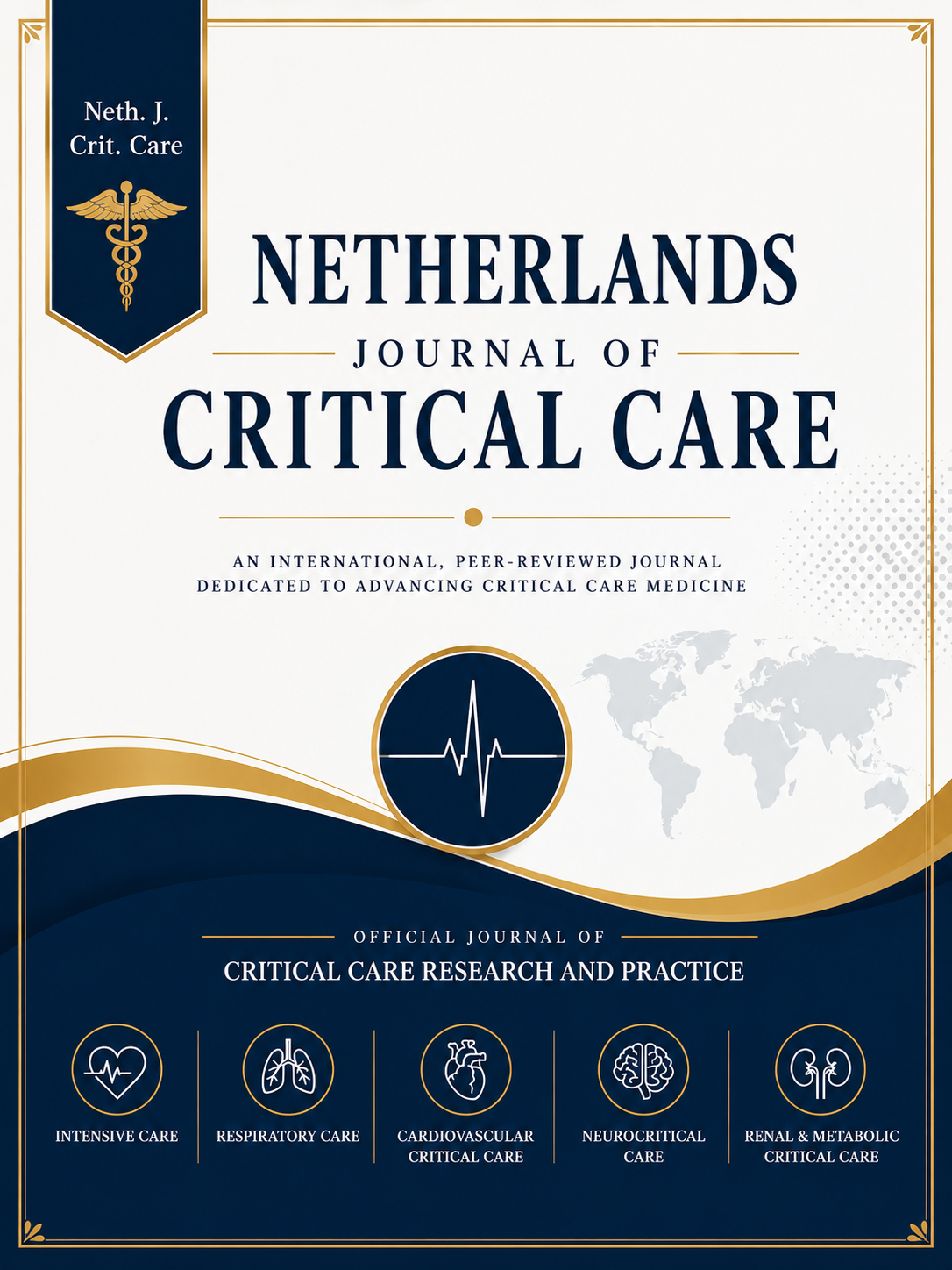
Volume 15, Issue 3
Downloads
 Download PDF
 Download XML
Citations
2420 Views
0 Downloads
Share this article




Indexations


Useful Links
Submit Article
Peer Review Process
Advertising Policy
Guidelines for Reviewers
Manuscript Submission
Guide for Authors
Guide for Editor
Editorial Policies
Publication Ethics Policy
Research Ethics Policy
Human and Animal Rights
Authorship and Contributorship
Informed Consent Policy
Conflicts of Interest
Preservation Policy
Generative AI Policy
Data Sharing Policy
Open Access Statement
Content Licensing
Copyright and Permission
Quality Control System
Policy of Screening for Plagiarism Process
Policy of Dealing with Allegations of Research Misconduct
Corrections and Retractions
Complaints and Appeals
Data and Reproducibility
Contact Us
Visits in the last year

View statistics
Netharland Journal of Critical Care
 This work is licensed under a Creative Commons Attribution-NonCommercial-NoDerivatives (CC BY-NC-ND) license. Open Access Publication.

Copyright © None. All rights reserved.