eISSN: None / ISSN: None
Register
Login
Netharland Journal of Critical Care
2011,
Volume 15,
Issue 6
: 269-275
Review
Choosing catecholamine therapy for shock
1
Department of Intensive Care, Erasme University Hospital, Université Libre de Bruxelles, Brussels, Belgium
Abstract
Shock is one of the leading causes of ICU admission, and is associated with a high risk of death, whatever its cause. Adrenergic agents are the most commonly used vasopressor agents. Although the alpha-adrenergic properties of these agents raise blood pressure, they can also variably stimulate the beta-adrenergic and dopaminergic receptors. Accordingly, these agents have different haemodynamic profiles as well as different metabolic profiles. Minimal beta-adrenergic stimulation may be beneficial in preventing the decrease in cardiac output related to the increase in left ventricular afterload associated with the correction of hypotension. However, excessive beta-adrenergic stimulation (which can occur as the doses of these agents are adjusted for the vasopressor effect can have profound metabolic effects and promote arrhythmias. Whether these differences in haemodynamic and metabolic profiles impact outcome has long been undefined. Two randomized trials comparing dopamine and norepinephrine as the first vasopressor agent raised major concerns on the use of dopamine (which was associated with tachycardia and increased arrhythmic events, and may be associated with an increased risk of death, especially in the subgroup of patients with cardiogenic shock). The place of epinephrine is not well defined: although this agent is associated with tachycardia, increased incidence of arrhythmic events, and undesired metabolic effects, their relevance to outcome has not been well established, as the studies were underpowered or biased by systematic addition of dobutamine. Altogether, these studies suggest that norepinephrine may be the first-choice adrenergic agent. Copyright © 2011, Nederlandse Vereniging voor Intensive Care.
Keywords
Adrenergic agents
Circulatory failure
Dopamine
Epinephrine
Norepinephrine
Outcome
License
Copyright (c) Netharland Journal of Critical Care
 Creative Commons License
This work is licensed under a Creative Commons Attribution 4.0 International License.
All papers should be submitted electronically. All submitted manuscripts must be original work that is not under submission at another journal or under consideration for publication in another form, such as a monograph or chapter of a book. Authors of submitted papers are obligated not to submit their paper for publication elsewhere until an editorial decision is rendered on their submission. Further, authors of accepted papers are prohibited from publishing the results in other publications that appear before the paper is published in the Journal unless they receive approval for doing so from the Editor-In-Chief.
Neth. J. Crit. Care open access articles are licensed under a Creative Commons Attribution-ShareAlike 4.0 International License. This license lets the audience to give appropriate credit, provide a link to the license, and indicate if changes were made and if they remix, transform, or build upon the material, they must distribute contributions under the same license as the original.
Recommended Articles
Right ventricular failure: Is it relevant for the intensivist?
96-97
Postoperative renal replacement therapy after hydroxyethyl starch infusion: A meta-analysis of randomised trials
4-9
Neuropsychological Predictors of Violent Criminal Behavior
1-6
Pocus series: Focused transoesophageal echocardiography, a view from the inside
130-139
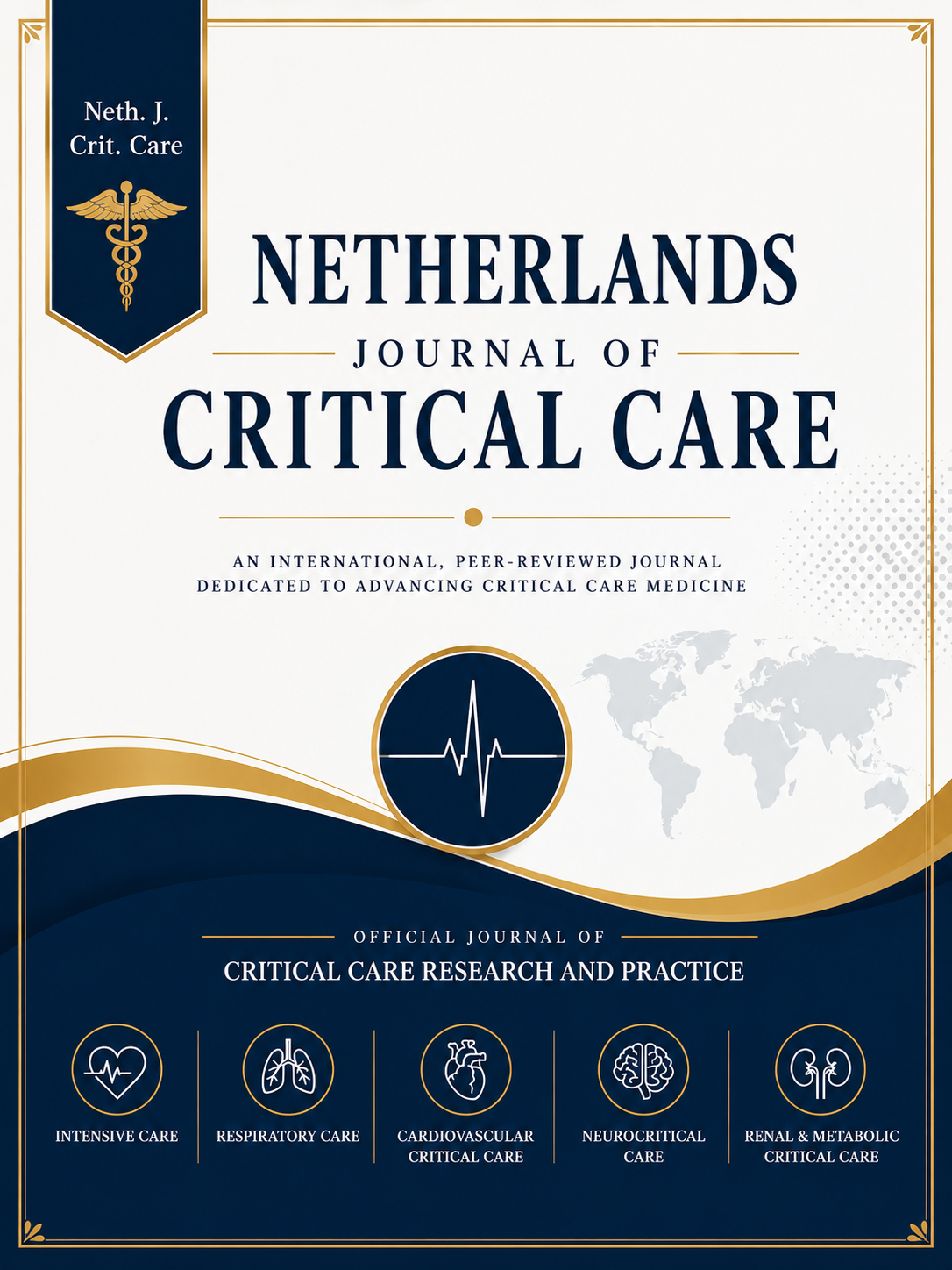
Volume 15, Issue 6
Downloads
 Download PDF
 Download XML
Citations
1238 Views
0 Downloads
Share this article




Indexations


Useful Links
Submit Article
Peer Review Process
Advertising Policy
Guidelines for Reviewers
Manuscript Submission
Guide for Authors
Guide for Editor
Editorial Policies
Publication Ethics Policy
Research Ethics Policy
Human and Animal Rights
Authorship and Contributorship
Informed Consent Policy
Conflicts of Interest
Preservation Policy
Generative AI Policy
Data Sharing Policy
Open Access Statement
Content Licensing
Copyright and Permission
Quality Control System
Policy of Screening for Plagiarism Process
Policy of Dealing with Allegations of Research Misconduct
Corrections and Retractions
Complaints and Appeals
Data and Reproducibility
Contact Us
Visits in the last year
View statistics
Netharland Journal of Critical Care
 This work is licensed under a Creative Commons Attribution-NonCommercial-NoDerivatives (CC BY-NC-ND) license. Open Access Publication.

Copyright © None. All rights reserved.