eISSN: None / ISSN: None
Register
Login
Netharland Journal of Critical Care
2010,
Volume 14,
Issue 3
: 201-205
Review
Passive leg raising
1
Medical Intensive Care Unit, Bicetre Hospital, le Kremlin-Bicêtre, France
2
Medical Intensive Care Unit, University Paris-South, le Kremlin-Bicêtre, France
Abstract
Objective: To assess whether the passive leg raising (PLR) test could predict fluid responsiveness and to describe its practical aspects. Summary of findings: Raising the legs to 45° transfers blood from the lower part of the body toward the cardiac chambers, increasing the right and left cardiac preload by a significant extent. The PLR test has been recently developed as a transient and reversible endogenous fluid challenge. An increasing number of studies have tested the ability of PLR for predicting the haemodynamic response to fluid in critically ill patients with acute circulatory failure. These studies established that the PLR effects on descending aortic blood flow, on subaortic blood flow or on pulse contour-derived cardiac output allow predicting fluid responsiveness with very good sensitivity and specificity. All the studies are concordant and the cut-off values of the PLR-induced increase in cardiac output or surrogates are quite similar between studies. It is important that prediction remains fully evaluable in patients with cardiac arrhythmias or spontaneous breathing activity. The PLR test is more accurate when it is started from the semi-recumbent rather than the supine position. Its assessment requires a real-time assessment of cardiac output, as enabled by oesophageal Doppler, echocardiography or pulse contour analysis. Conclusions: PLR is now well demonstrated to be a reliable test for predicting fluid responsiveness, even in patients with spontaneous breathing activity or arrhythmias. © 2010, Nederlandse Vereniging voor Intensive Care.
Keywords
Cardiac preload
Fluid responsiveness
Passive leg raising
Volume expansion
License
Copyright (c) Netharland Journal of Critical Care
 Creative Commons License
This work is licensed under a Creative Commons Attribution 4.0 International License.
All papers should be submitted electronically. All submitted manuscripts must be original work that is not under submission at another journal or under consideration for publication in another form, such as a monograph or chapter of a book. Authors of submitted papers are obligated not to submit their paper for publication elsewhere until an editorial decision is rendered on their submission. Further, authors of accepted papers are prohibited from publishing the results in other publications that appear before the paper is published in the Journal unless they receive approval for doing so from the Editor-In-Chief.
Neth. J. Crit. Care open access articles are licensed under a Creative Commons Attribution-ShareAlike 4.0 International License. This license lets the audience to give appropriate credit, provide a link to the license, and indicate if changes were made and if they remix, transform, or build upon the material, they must distribute contributions under the same license as the original.
Recommended Articles
Right ventricular failure: Is it relevant for the intensivist?
96-97
Postoperative renal replacement therapy after hydroxyethyl starch infusion: A meta-analysis of randomised trials
4-9
Neuropsychological Predictors of Violent Criminal Behavior
1-6
Pocus series: Focused transoesophageal echocardiography, a view from the inside
130-139
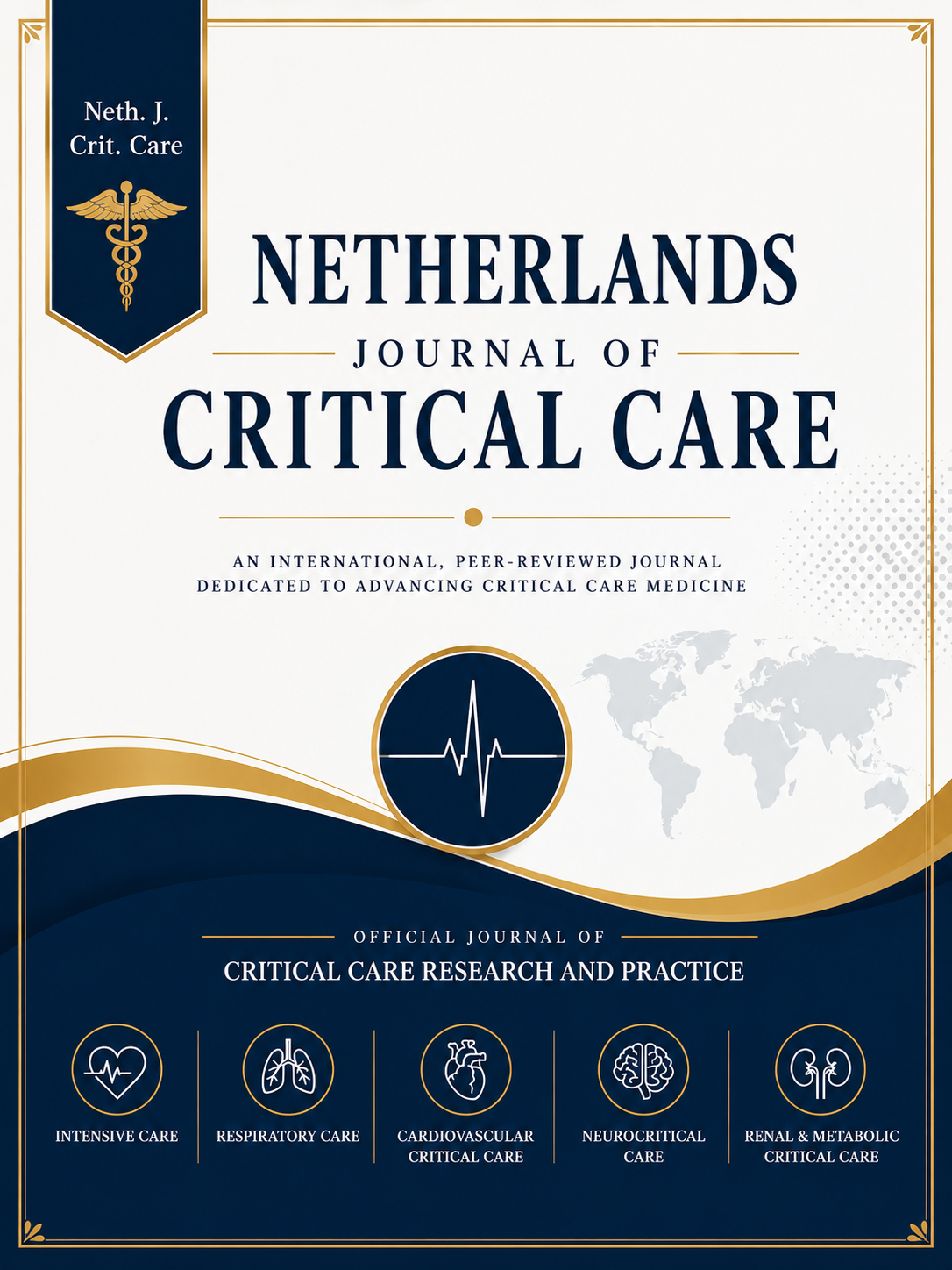
Volume 14, Issue 3
Downloads
 Download PDF
 Download XML
Citations
1390 Views
0 Downloads
Share this article




Indexations


Useful Links
Submit Article
Peer Review Process
Advertising Policy
Guidelines for Reviewers
Manuscript Submission
Guide for Authors
Guide for Editor
Editorial Policies
Publication Ethics Policy
Research Ethics Policy
Human and Animal Rights
Authorship and Contributorship
Informed Consent Policy
Conflicts of Interest
Preservation Policy
Generative AI Policy
Data Sharing Policy
Open Access Statement
Content Licensing
Copyright and Permission
Quality Control System
Policy of Screening for Plagiarism Process
Policy of Dealing with Allegations of Research Misconduct
Corrections and Retractions
Complaints and Appeals
Data and Reproducibility
Contact Us
Visits in the last year
View statistics
Netharland Journal of Critical Care
 This work is licensed under a Creative Commons Attribution-NonCommercial-NoDerivatives (CC BY-NC-ND) license. Open Access Publication.

Copyright © None. All rights reserved.